- info@g-aircon.com
- Open 24 hours
AC Gas Refill in Vadodara: Signs Your AC May Be Low on Refrigerant
Your AC is switched on, but the room takes much longer to cool.
You lower the temperature from 24°C to 20°C, but the difference is barely noticeable.
The first thought is often:
“AC mein gas kam ho gayi hogi.”
Sometimes that is correct.
But low refrigerant is not the only reason an AC stops cooling, and simply asking a technician to refill the gas without checking the system can result in the same problem returning again.
Refrigerant is the substance that circulates through an air conditioner’s closed cooling system and transfers heat from inside the room to the outside. Under normal conditions, an AC does not continuously consume refrigerant like a vehicle consumes fuel. If the refrigerant charge becomes low, a leak or another system issue generally needs to be investigated.
If you are considering an AC gas refill in Vadodara, here are the signs you should understand first.
What Does “AC Gas” Actually Mean?
People commonly call it AC gas, but technically it is called refrigerant.
The refrigerant travels through the indoor and outdoor portions of the AC, repeatedly changing pressure and state as part of the refrigeration cycle.
Its job is to absorb heat from the indoor space and release that heat outside.
Without the correct quantity of refrigerant, the system cannot transfer heat effectively, which can lead to poor cooling and longer running times.
Different air conditioners may use different refrigerants depending on their model and age. The correct refrigerant type and charging quantity should therefore follow the manufacturer’s specifications rather than being guessed.
Does Every AC Need Gas Refilling Every Year?
No.
This is one of the biggest misconceptions around AC maintenance.
An AC is designed as a closed-loop refrigerant system. Refrigerant should not normally disappear every summer simply because the AC has been used regularly.
If your AC needs frequent gas refilling, the real question should be:
“Where is the refrigerant going?”
Low refrigerant commonly points toward leakage somewhere in the system, such as refrigerant lines, joints, coils or connections.
Refilling gas repeatedly without addressing an active leak may provide only temporary cooling.
7 Signs Your AC May Be Low on Refrigerant
1. Your AC Is Running but Not Cooling Properly
This is the most obvious symptom.
You may notice that the AC is running continuously, but the room still does not reach the temperature set on the remote.
Instead of becoming comfortably cool within a reasonable period, the room remains warm or takes unusually long to cool.
Reduced cooling capacity and failure to reach the set temperature are recognised symptoms associated with low refrigerant.
However, remember that dirty filters, blocked condenser coils and other faults can produce similar symptoms.
That is why refrigerant pressure should be checked before deciding that gas refilling is necessary.
2. The Air Coming From the AC Is Not Cold Enough
Stand near your split AC’s indoor unit.
Is the airflow reasonably strong but the air does not feel properly cold?
Low refrigerant can reduce the AC’s ability to absorb heat inside the room, resulting in air that feels warmer than expected.
But weak cooling can also come from:
- Dirty evaporator coils
- Blocked filters
- Dirty outdoor condenser
- Compressor issues
- Incorrect AC settings
So this symptom alone cannot confirm low gas.
3. Ice Is Forming on the AC Pipe or Indoor Coil
Visible ice around the copper piping or indoor evaporator area is something you should take seriously.
When refrigerant pressure becomes too low, the evaporator coil can become excessively cold. Moisture in the surrounding air may then freeze on the coil or refrigerant line.
You may notice:
- White ice on copper pipes
- Frost near the indoor unit
- Water dripping after the ice melts
- Cooling gradually becoming weaker
Do not assume the correct solution is simply to remove the ice.
The reason behind the freezing still needs to be diagnosed.
Low refrigerant is one possible cause, but restricted airflow can also contribute to coil freezing.
4. The AC Keeps Running for a Long Time
Normally, an AC cools the room until the desired temperature is reached and then adjusts its operation accordingly.
When refrigerant is insufficient, the AC may struggle to remove enough heat.
As a result, you may notice the system operating for unusually long periods without reaching the selected temperature. Carrier identifies continuous operation without achieving the set temperature as one indicator of low refrigerant.
Longer operation also means the compressor and other components are working harder.
5. Your Electricity Consumption Has Increased
If an AC cannot cool efficiently, it may operate for longer than normal.
That additional runtime can increase electricity consumption.
Low refrigerant is one possible reason an AC may run harder and longer, although dirty coils, dirty filters, incorrect sizing and other mechanical problems can produce similar behaviour.
Therefore, a high electricity bill does not automatically mean you need AC gas filling.
It is a reason to get the overall system inspected.
6. You Hear a Hissing or Bubbling Sound
A refrigerant leak may sometimes produce an unusual sound.
A hissing sound can occur when refrigerant escapes through a small opening, while bubbling-type sounds can also be associated with certain refrigerant leaks.
If the sound is coming from the copper piping, indoor coil or outdoor unit and cooling performance has also dropped, a technician should inspect the system.
Do not try to locate or repair refrigerant leaks yourself by opening the AC.
7. You Refilled the Gas Recently but Cooling Has Reduced Again
This is perhaps the clearest sign that simply adding more refrigerant may not solve the underlying problem.
Suppose your AC stopped cooling.
A technician refilled the gas.
The AC worked properly for a few weeks or months.
Now the same cooling problem has returned.
That strongly suggests the system should be checked for leakage rather than automatically receiving another refill.
Because refrigerant circulates inside a sealed system, repeated refrigerant loss generally warrants leak detection and repair.
Why Does AC Gas Become Low?
Refrigerant does not normally get “used up.”
Instead, low refrigerant can occur because it escapes from the cooling system.
Possible causes include:
Leakage From Copper Pipes
Damage, vibration or wear can create small leaks in refrigerant piping.
Loose or Weak Connections
Connections made during installation can sometimes develop leakage over time.
Evaporator or Condenser Coil Leakage
Small holes or corrosion in coils can allow refrigerant to escape.
Physical Damage
Accidental damage to the piping or outdoor unit can create leakage.
Installation Problems
Improperly completed joints or refrigerant connections may result in gradual loss.
Carrier identifies line damage, weak joints, corrosion and physical damage among common sources of refrigerant leakage.
Can AC Gas Become Low Without a Leak?
Under normal operation, refrigerant should remain inside the sealed circuit.
This means an AC should not require a routine refrigerant top-up simply because it has been operating for a certain number of months.
There are situations where refrigerant charging may be necessary after installation, relocation or system repair, but a previously correctly charged sealed system should not continuously lose refrigerant.
If someone tells you:
“Every AC needs gas every year.”
That is not technically correct.
What Happens During Professional AC Gas Refilling?
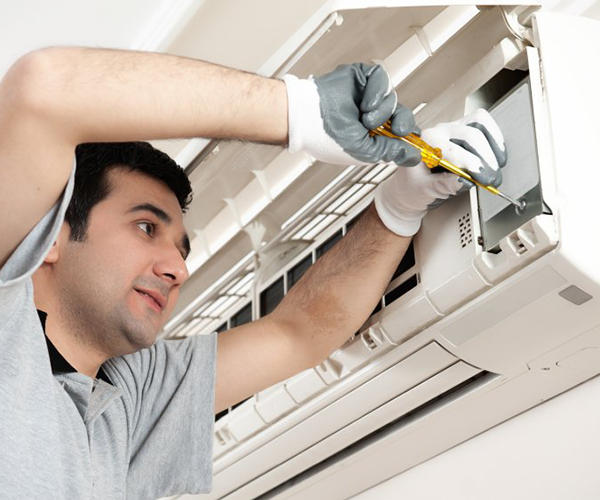
Proper AC gas refilling should involve more than attaching a cylinder and adding refrigerant.
A technician may first inspect the system and check operating pressure and temperature to determine whether the refrigerant charge is actually low. G-Aircon states that its AC servicing process in Vadodara includes refrigerant-pressure inspection and gas refilling when required.
If leakage is suspected, the next steps can include:
1. Diagnosing the Cooling Problem
The technician checks whether poor cooling is actually refrigerant-related.
2. Checking for Leakage
Refrigerant lines, joints and coils may be inspected for leaks.
Professional leak-detection methods can include pressure testing and specialised leak-detection equipment.
3. Repairing the Leak
If a repairable leak is identified, it should be addressed before the system is properly recharged.
4. Evacuating the System Where Required
Depending on the repair performed and the condition of the system, a vacuum process may be used to remove unwanted air and moisture.
5. Charging the Correct Refrigerant
The AC should receive the appropriate refrigerant type and quantity specified for that particular unit.
6. Testing Cooling Performance
The system should then be operated and checked to confirm that cooling has been restored.
A professional recharge process aims to restore the system to the correct manufacturer-specified refrigerant charge rather than simply adding an arbitrary amount.
AC Gas Refill vs AC Gas Leak Repair: What’s the Difference?
These are related services, but they are not the same thing.
AC Gas Refill
Refrigerant is added to restore the required charge inside the AC.
AC Gas Leakage Repair
The source through which refrigerant is escaping is identified and repaired.
If the AC simply receives a refill while an active leak remains, the gas may leak out again.
The correct sequence in a leaking system is generally:
Find the leak → repair the leak → test the system → recharge with the correct refrigerant.
Don’t Ask for Gas Refilling Before the AC Is Diagnosed
This is particularly important for customers.
If your AC is not cooling, saying:
“Bas gas bhar do.”
may actually lead to unnecessary expense if refrigerant is not the problem.
Poor cooling can also result from:
- Dirty filters
- Dirty condenser coil
- Frozen evaporator coil
- Outdoor fan problems
- Compressor problems
- Electrical faults
- Improper room sizing
- Incorrect AC settings
Carrier lists refrigerant leakage alongside several other common causes of an AC running without cooling properly.
A proper technician should diagnose the cause first.
Can Low Refrigerant Damage the Compressor?
Operating an AC with an unresolved refrigerant problem can put additional stress on the cooling system.
Low refrigerant can cause the AC to run for longer periods and may contribute to conditions that can damage major components if the problem is ignored. Carrier advises addressing refrigerant leaks promptly rather than continuously operating an underperforming system.
So if your AC is showing serious symptoms such as:
- No effective cooling
- Heavy ice formation
- Continuous operation
- Repeated refrigerant loss
getting it checked early is preferable to waiting until the system stops entirely.
Does Gas Refilling Make an AC Cooler?
If low refrigerant is genuinely the reason for reduced performance, restoring the correct refrigerant charge can restore proper cooling.
But more refrigerant does not mean more cooling.
An AC is designed to operate with a specified refrigerant charge.
Both incorrect undercharging and incorrect overcharging can create performance and reliability problems.
That is why the refrigerant amount should be determined technically rather than by guessing.
How Often Should AC Gas Be Checked?
There is no universal rule saying gas must be refilled every six months or every year.
Instead, refrigerant should be investigated when the AC shows symptoms suggesting a possible charge or leakage problem.
During professional servicing, a technician may assess system performance and refrigerant-related conditions when necessary.
G-Aircon offers AC servicing and repair in Vadodara and lists refrigerant-pressure inspection and gas refilling among the services performed where required.
AC Gas Refill in Manjalpur, Makarpura, Tarsali & Vadodara
For someone searching “AC gas refill near me”, locality matters because cooling problems often need on-site diagnosis.
G-Aircon provides AC repair and servicing across Vadodara and has dedicated local service coverage for several areas. Its website lists AC repair, servicing, installation and maintenance services across the city.
Customers looking for AC gas-related service around:
- Manjalpur
- Makarpura
- Makarpura GIDC
- Tarsali
- Waghodia Road
- Sun Pharma Road
- and nearby Vadodara areas
can arrange an inspection before determining whether the AC actually requires gas refilling.
G-Aircon also maintains a dedicated service page for Makarpura GIDC and local service pages across Vadodara.
When Should You Call an AC Technician?
Arrange professional inspection if:
- Your AC is running but giving poor cooling
- Air is not cold enough
- Ice is forming on the AC pipe
- Gas was filled recently but cooling has reduced again
- The AC runs continuously
- You hear hissing around the refrigerant line
- The outdoor unit is running but the room remains warm
- The AC repeatedly needs refrigerant
- Cooling suddenly dropped without an obvious reason
These symptoms do not prove refrigerant is low, but they justify proper diagnosis.
How to Reduce the Chances of Refrigerant Problems
Not every refrigerant leak can be prevented, but good installation and maintenance can reduce avoidable issues.
Some practical steps include:
Use trained technicians for installation.
Poor refrigerant-line connections can contribute to leaks.
Avoid damaging exposed copper piping.
Physical damage may create cracks or weak points.
Don’t ignore recurring poor cooling.
A small problem is easier to investigate before the AC loses most of its refrigerant.
Get recurring leaks repaired instead of repeatedly topping up gas.
Maintain the overall AC system.
Proper airflow and clean components help the AC operate under normal conditions.
AC Gas Refill Should Be a Diagnosis, Not a Guess
When an AC stops cooling, refrigerant is often blamed first.
Sometimes that diagnosis is correct.
Sometimes the problem has nothing to do with gas.
The smarter approach is:
Poor cooling → system inspection → refrigerant check → leak detection if needed → repair → correct gas refill.
That gives you a better chance of solving the actual problem rather than paying for repeated temporary fixes.
For AC gas refill and AC repair in Vadodara, G-Aircon provides servicing and troubleshooting for residential and commercial AC systems across the city.
Contact G-Aircon:
+91 95589 01793
G-Aircon is based in Makarpura, Vadodara, and lists 24-hour availability on its website.
About Us
Welcome to G – Aircon, your trusted partner for all your air conditioning needs. With years of experience and a commitment to excellence, we are proud to be a leading provider of AC services in Vadodara.
Links
Our Services
Contact Info
- D - 18, Sarawati Nagar, B/H Roses Garden, Old Chhani Road, Vadodara - 390002
- Sameer Khan: +91 95589 01793
- info@g-aircon.com